Gain executive support
It is critical to gain support from company executives to ensure the success of your ERG. Reach out to top level management people like the COO, CEO or CFO and ask for support for your group.
Develop a leadership team
The backbone of any group are the leaders within it.
Leverage Existing ERGs
Meet with previously established diversity groups. This is a great way to gain knowledge of the initial dos and don’ts when forming the ERG.
Increase Awareness
Draw up a plan with your leadership team to develop strategies for recruiting new members. Mediums to consider include: newsletters, company intranet sites, mass email campaigns, flyers included in paychecks, hosting events, advertisements on inter-office boards, word-of-mouth and face-to-face.
Secure Funding
Funding could come from a number of areas such as company diversity budget, membership fees, representative department’s budget, and grants.
Develop Goals/Mission/Vision
-The name should reflect main goals and objectives of the group.
-The ideas should collectively define the group and its purpose.
-Example goals: Increase meeting attendance, increase membership. It is good idea to conduct end-of-year surveys and
determine what changes can be made to improve the ERG.
Confirm Group Structure
-Determine the day/time/location of meetings
-Consider specific roles for group members to take
-Be aware of scheduling conflicts and make plans for alternative meeting agendas (teleconference/video conference)
Develop Business Case
By identifying a business need or shortcoming, the group can generate interest among members and executive sponsors. By solving a key business problem through the ERG you can assure active recruitment/retention and budgeting strategies.
Maintain Momentum
One of the biggest challenges of a successful ERG is maintaining popularity among members. Here are some suggested activities to maintain momentum in your ERG: in-house networking events; workshops on topics related to the ERG; outside speakers.
Measure Success
Benchmark yourself against other company resource groups.
Introduction by Rosalyn Taylor O’Neale
VP, Chief Diversity & Inclusion Officer
Campbell Soup Company
When Employee Resource Groups (ERGs) began in the late 70’s they were often clandestine gatherings where individuals shared challenges and success strategies. ERGs provided a safe haven for women and African-American pioneers to connect and gather enough strength to return to disinterested and often hostile workplaces where their words and work were overlooked or invisible. One leader, David Kearns, then CEO at Xerox, recognized the power of this informal network and invited them to help Xerox become an employer of choice.
Fast forward to 2012 and employee resource groups—also known as affinity groups or employee networks—have evolved from safe haven social clubs into collaborative business partnerships engaged in everything from recruiting and retention efforts to marketing products and services to connecting companies to consumers.
Everyday there are new people challenges and opportunities—four generations in the workplace and shifting consumer preferences based on merged-cultural and multi-cultural experiences and communities.
How does a CEO keep up with these rapid changes while paying attention to legislative shifts, global and local demands, and economic chaos? Employee Resource Groups are one of the best kept secrets at her or his disposal.
Recruiting New Members
Nielsen PRIDE (LGBT)
Marty Siewert, Group VP
Internal newsletters are combined with word of mouth. Broad awareness of existence is key to generating interest; individual engagement via word of mouth is most effective at translating interest into participation.
CSC Abilities First Network
Leanne Thomas, Sr. Manager HR
The use of C3 (CSCʼs internal collaboration site) and broadcast messages are found to be most successful, allowing the ERG to reach a large number of people at the same time. The C3 environment allows the target audience to provide instant feedback and input on events and objectives of the employee resource group.
Alliant Energy Multicultural Network
Jamie Toledo, Manager, Corporate D&I
Social media allows the Alliant Energy Multicultural Network the opportunity to share the mission of the group and to be interactive and answer questions. This particular ERG holds an awareness breakfast each year, during this time they recruit and network with new potential members.
Mercer Women In Business
Sissy Pitts, Senior Client Services Team Lead
“Word of mouth is great,” says Pitts. “Friends bring friends to meetings, while talking up the events we do and the goals of the network. Email is great too since it goes to a broader audience.”
Shell Oil POWER*
Cynthia Rushing, Strategic Planning Manager
POWER is unique in that it is an intranetwork, which means that membership comes from those Multicultural ERGs. However, POWER prides itself on generating excitement from events primarily due to face-to-face interaction.
*Promoting Opportunities for Women across Ethnicity & Race
By Dr. Richard, Lewis, Jr. and Joanne Ford-Robertson
The United States is undergoing unprecedented societal change. Major differences are beginning to emerge in American society with amazing demographic changes in racial and socio-economic composition. Hispanics and Asian-Americans are the fastest growing ethnic groups and the American middle class is becoming proportionately smaller each year. The United States in 2050 will be very different from the country we know today.
The age composition of the American population overshadows all other demographic change components. In fact, the most dramatic change impacting society is age dynamics. For the first time in United States history, the workforce is comprised of individuals from four distinct age cohorts. This has created new and profound challenges in the American workplace.
Age Cohorts and Population Distribution
An age cohort is a grouping of people assembled by an age range who have common historical experiences. These age ranges are generally correlated with important societal and world events creating bonding through shared experiences. In contemporary American society there are five distinctive age cohorts; Traditionalists, Baby Boomers, Generation X, Millennials, and the iGeneration. With the exception of the iGeneration, individuals from each of these age cohorts are represented at various levels in the contemporary workplace.
The Traditionalists are the oldest individuals in American society. They were born between 1922 and 1945. Traditionalists are known as loyalists, veterans, and the Greatest Generation, having won World War II and endured the Great Depression. Baby Boomers are the children of Traditionalists and they are the second oldest grouping of individuals in the United States. They were born between 1946 and 1964. Boomers have been described as optimistic and driven at work and play. The Vietnam War, the Civil Rights Movement, and space travel frame their historical reality. There are 77 million Baby Boomers.
Generation X is one of the younger age cohorts and it is comprised of the children of Baby Boomers. Individuals in this grouping were born between 1965 and 1979. They are known as the baby busters and were characterized as “latch-key” kids. The fall of the Berlin Wall, the explosion of the Space Challenger, and MTV are elements that frame this group’s historical focus. There are 49 million Generation Xers.
The Millennial cohort is the youngest age group in the workplace. They are the children of Baby Boomers and Generation Xers. Individuals in this group were born between 1980 and 2000. An around-the-clock world, the World Trade Center attacks, homegrown terrorism, cell phones, and the expansion of the internet are historical events that frame this group’s reference. There are about 74 million Millennials.
The iGeneration are the children of Millennials and Generation Xers and were born after 2000. Their focus is inward and it is being fashioned by iPods, iPads, and other technology which emphasize the individual. There are 44 million in the iGeneration and it will continue to expand.
The age composition of the American population will experience dramatic changes over the next 40 years. United States Census Bureau information from 2000 shows a line graph with the largest portion of the population, for both men and women, between 20 and 59 years of age (see Figure 1.)
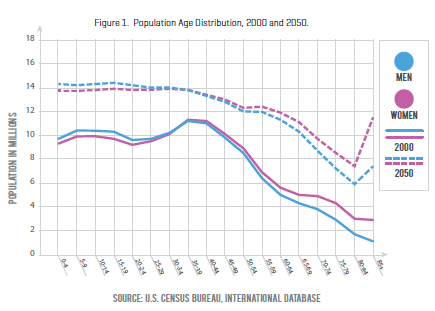
Projections illustrate a much different age composition by 2050. Figure 1 shows a much older American population with large numbers of men and women throughout the age groupings. It is estimated there will be 11 million women and 7 million men over the age of 85.
What these projections imply is that people will live longer and, therefore, be in the workplace longer in comparison to other historical periods. This situation will lead to potential competition and conflict between age groupings. In 2011 there are four distinct age cohorts in the American workforce; Traditionalist, Baby Boomers, Generation X, and Millennials. Each of these age cohorts brings a unique perspective to the workplace. This creates challenges within organizations with respect to employees working together effectively and efficiently.
Age Cohorts and Workplace Dynamics
Each age cohort can be identified with a unique set of characteristics and values. These delineate membership and the way work is viewed and approached (seeTable 1.) Workplace dynamics are impacted by five general characteristics associated with each cohort. These entail perception of the organization, work ethic, view of authority, type of leader, and social relationships. All four cohorts view organizations differently. Traditionalists tend to see the stability organizations provide to society and lifestyle. Baby Boomers focus on the strategic efforts that emanate from organizations while Generation Xers are more concerned with the operational nature of organizations. Lastly, Millennials center on the particularistic aspects of organizations which makes it difficult for them to determine the big picture.
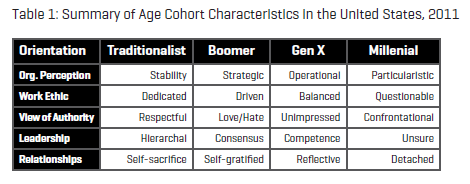
Work ethic is defined as a set of values placed on hard work and diligence. Some of the values of a work ethic are reliability, individual initiative, and appropriate social skills. Traditionalists tend to view work as a dedication or a life calling. Baby Boomers generally display a work ethic that can be characterized as driven. They tend to exhibit this orientation in both work and leisure time activities and expect others to do the same. Individuals in Generation X tend to have a balanced orientation toward work. They work diligently and do not allow workplace issues to interfere with their personal lives. Lastly, individuals in the Millennial generation have a questionable work ethic because many of them have not had permanent positions. Some are just completing college and have not had exposure to the contemporary workplace.
Age cohorts view authority very differently. Traditionalists are very respectful to people in positions of authority. Baby Boomers are quite similar in viewing authority if they are in charge. If they are not in a leadership position, Boomers tend to undermine those in authority positions. Generation X members are generally unimpressed with those in authority positions while Millennials tend to be confrontational.
How each cohort views leadership is tied closely to it sees authority. Where individuals in Generation X are unimpressed with those in authority positions, they demand that leaders be competent. Baby Boomers gravitate to consensual leadership and Traditionalists are strongly linked to perceiving leadership as a hierarchal relationship that should not be questioned. Leadership for Millennials can best be described as unsure at this time because of their limited participation in the workplace.
Relationships, whether they be personal or organizational, is another age cohort characteristic that can affect workplace dynamics. Detached relationships are fostered through technology (cell phones, IM, e-mail, texting, etc.) with little to no face-to-face contact. The Millennial generation is the first cohort to have primarily detached relationships. Generation X tends have more of a reflective approach to relationships. Members generally think through the implications of relationships and how the implications may affect them. This has led to a perception of Generation X being non-committal to work and organizations. Traditionalists view relationships as strong commitments based on self-sacrifice. In others words, they will sacrifice themselves for the good of the organization or their family. Lastly, Baby Boomers center their relationships on personal gratification. Generally, they pursue their professional and personal ventures at the expense of their families and friends.
All five of these age-based characteristics influence employee behavior in the contemporary workplace. As a result, individuals may view and frame organizational issues quite differently. Each characteristic has the potential for exacerbating employee miscommunication and conflict. Therefore, establishing an efficient and effective workplace becomes more of a challenge for organizations.
Determining Impact of Generational Issues
Organizations must begin to determine how they will be impacted by generational issues and there are several ways to accomplish this. One is to complete a transition impact assessment. This is a systematic evaluation of key demographic variables (including age composition) and pinpointing their current and future influence on the organization. Another approach is workplace operational planning. This entails empowering employees to establish the workplace rules, etiquette, and work hours bridging age cohort differences. Application of technology in the workplace is yet another approach for addressing generational issues. This involves findings ways to more effectively use cell phone, texting, and other cutting edge technologies to link employees and enhance work production. A final approach is mentoring and coaching. Organizations will need professional and supervisory level personnel to become mentors and coaches for younger employees. Enhancement of basic social and critical thinking skills will occur through this interaction.
The age composition of American society will continue its evolution into a much older population over the next four decades. The workforce and workplace will experience similar changes. Age dynamics and the interactions across age cohorts will dominant the very nature of work in the United States. Implementing innovations which mitigate age-related issues and maintain a vibrant, productive work environment represent the major challenge most organizations will face to remain successful.
Richard Lewis, Jr. is Professor of Sociology at the University of Texas at San Antonio. In additional to academic duties, Lewis is a consultant and has conducted diversity related professional development training and strategic planning for 20 years.
Joanne Ford-Robertson is also a consultant at Round Top Consulting Associates, LLC, in San Antonio, Texas. She teaches sociology at the University of Texas at San Antonio.
Br Grace Austin
Everything needs a facelift once in awhile. Including America’s travel advertising campaign. Adopting the tagline, “United States of Awesome Possibilities,” the campaign, launched in March, is the brainchild of the Corporation for Travel Promotion (CTP), a private-public partnership formed in 2010 to encourage tourism, with a marketing budget of $200 million. The push is designed to promote leisure and business travel to drive economic growth and jobs in the tourism industry. Tourists from the UK, Canada, Germany, Mexico, and Japan are the main targets.
The CTP’s goal is to create a “21st-century brand” which “symboliz[es] the boundless possibilities of the U.S.,” as well as representing America’s “diversity.”
“What is so compelling about the United States is that no one thing can explain who we are as a nation,” CTP’s Chris Perkins said in a statement. “Each visitor and each experience helps create the fabric of American culture, and Brand USA embodies this spirit. When we launch our global marketing and advertising campaign next year, we will be able to reach audiences around the world by showcasing the best of America and spreading the message that we welcome visitors with open arms.”
A new logo has been designed by The Brand Union, featuring many dots forming the letters USA. The dots are supposed to represented diverse colors and people across the country. People are encouraged to visit the website, discoveramerica.com.
The easily navigable, large-print website includes featured destinations, ‘Top 10 Lists,’ ‘Trip Ideas,’ and entertaining ‘Travel Tips.’
One such tip warns: “Health care is superior in the U.S. but it can be very expensive because there is no universal health care.”
Other tips refer to ‘social customs,’ which include: “Keep your voice down when talking on a mobile phone in public.”
And for your transportation needs: “Hitchhiking is illegal in many U.S. states.”
The site has been marketed as a one-stop shop, with federal agencies, transportation companies like rental cars and buses, and travel agencies and tour operators links. The use of social networking is also apparent through various Facebook links.
Advertising ads begin airing this spring.
Tourism in the U.S. peaked in 2000, with 26 million overseas arrivals. Since then, global views of the United States have deteriorated with the invasions of Iraq and Afghanistan, extra security measures placed post 9/11, and the recent economic downturn.
The number of visitors from the U.K. the United States’ largest overseas market, has declined since a record high 4.7 million in 2000.
A $200 million budget exceeds promotional spending of the top ten countries’ tourism budgets, including Mexico, the United Kingdom, and Australia. This is a dramatic increase since 2005, when the U.S. had no marketing budget.
Experts estimate the U.S. lost potentially $606 billion in tourism revenue, largely attributed to a lack of a cohesive, national tourism campaign. International tourists supposedly stay longer than domestic visitors, another reason for the marketing push.
While advertisements have begun showing, it is still unclear whether the U.S. advertising campaign will bring in more tourists, and more importantly, generate more income.
September 20, 2011
This morning, I turned on the news as I normally do about 5:30 each morning to hear the daily weather forecast and listen for any breaking local, national, or world events.
Today, I was especially curious to see what would be on the news on this historic day for the U.S. military. Just after midnight, 10 U.S.C. § 654, commonly known as the “Don’t Ask, Don’t Tell” (DADT) law, was repealed, allowing gay and lesbian service members to choose to reveal their sexual orientation without the fear of being separated from the service. Today had a January 1, 2000 familiar feel to it for me. You may recall 1999 when many people were concerned about the Y2K computer bug and what would happen to all the computers when we rolled over to the new millennium. When we woke up on the first day of the 21st century, there were some minor glitches, but life went on pretty much as usual despite the doom and gloom predictions. When we woke up today, despite predictions of significant impact, post-repeal military life goes on as usual. The news trucks are not lined up outside the gate to cover a significant event, protesters are not swarming the Academy, and there isn’t a gay rights parade streaming across campus. Cadets are starting class, faculty and staff are getting on with their day, and people are getting along with each other just as they were yesterday. This morning, the sun came up as normal on a beautiful, crisp Colorado day. The main thing that changed was that a portion of our population started their day carrying a much lighter load because they don’t have to worry about losing their ability to serve just because of who they are. For those individuals, I imagine the sunrise today was just a little brighter and more meaningful than it was yesterday.
Why is the DADT repeal, like Y2K, just another day at our campus? From July until Thanksgiving of 2010, I served at the Pentagon as the Air Force writer on the Secretary of Defense’s Comprehensive Review Working Group (CRWG) study of the impact of repealing the law known as “Don’t Ask, Don’t Tell” (DADT). I assisted with data analysis and the writing the main Report of the Comprehensive Review of the Issues Associated with a Repeal of “Don’t Ask, Don’t Tell.” In addition, I had the privilege of leading the team responsible for writing the companion Support Plan for Implementation, which served as the basis for training across the Department of Defense for over two million active duty and reserve Service Members. The CRWG completed one of the largest personnel studies in the history of the U.S. military, soliciting the views of over 500,000 active duty and reserve service members and spouses and analyzing nearly 225,000 responses from surveys, focus groups, and online entries. In addition, the Working Group studied the history of racial and gender integration in the U.S. military, analyzed the experiences of foreign militaries that allow open gay and lesbian service, and reviewed the experiences of domestic organizations such as fire and police departments. We talked to people and advocacy groups from both sides of the issue. Using a diverse panel of experts representing all branches of the service, enlisted and officer, combat veterans and civilian employees, we assessed the potential impact of repeal on military readiness, effectiveness, cohesion, recruiting, and retention. All the data sources and analysis pointed to the same conclusion—repeal of DADT would not have a debilitating effect on military cohesion, effectiveness, readiness, recruiting, or retention. The two CRWG Co-Chairs, Mr. Jeh Johnson, DoD General Counsel, and Gen Carter Ham, current Commander of United States Africa Command, stated in the conclusion of the report, “We are both convinced that our military can do this, even during this time of war. We do not underestimate the challenges in implementing a change in the law, but neither should we underestimate the ability of our extraordinarily dedicated Service men and women to adapt to such change and continue to provide our Nation with the military capability to accomplish any mission.”
While the data are compelling, I personally believe that DADT repeal will not be a troublesome event primarily because of what the Co-chairs called “the ability of our extraordinarily dedicated Service men and women.” The integrity and values of the U.S. service member will ensure that our nation’s defenses do not skip a beat as a result of the repeal of DADT. Service Members, from our youngest cadets and enlisted troops up to the Chairman of the Joint Chiefs of Staff, understand their duty to the laws of our nation that is embodied in the Oath of Office. We learned in Korea, after President Truman ordered a desegregated military, that black and white soldiers were more effective fighting side-by-side than they were fighting in separate but equal units. We learned at the service academies in 1976 that men and women could train and study side-by-side and that we would be stronger as an institution because of our more diverse student population. With a DADT repeal, we will learn that gay and straight cadets will respectfully serve side-by-side and we will be stronger as a result.
Diversity certainly comes with challenges. The military, like the rest of our society, has struggled with racial tension, sexual harassment and discrimination, and violence against minority groups. With the DADT repeal, we would be naïve to think that we will not have isolated incidents related to a person’s sexual orientation or religious/moral beliefs about homosexuality. But these incidents will pale in comparison to the strength the military gains through recruiting and retaining a diverse force. You would be hard pressed to find many who would support the idea that our military is weaker because we have women or persons of color serving our nation in the uniformed military service. We have many measures of diversity at the Air Force Academy to include race, ethnicity, gender, religion, prior-enlisted, and athletic status. We recruit students from all 50 states and U.S. territories as well as several of our allied partners. This broad perspective on diversity makes us better as an institution and requires our students to learn how to build successful teams through dignity, courtesy, and respect. In our culture, respect is not just as a good idea, it is a military necessity that we are all duty-bound to follow.
As Admiral Mike Mullen stated in his testimony to Congress in February of 2010, repealing DADT is an integrity issue. Serving with integrity means staying true to ourselves while staying true to our duty to support and defend the Constitution of the United States. With the repeal of DADT, our duty to uphold our Oath of Office remains unchanged. We must do our duty to keep our standards high; create an environment free from barriers that prevent people from rising to the highest level of responsibility possible; and ensure all who serve are able to do their duty without fear of reprisal, harassment, or prejudice. We must do our duty to protect personal beliefs while honoring and respecting all who serve; evaluate others based solely on individual merit, fitness, and capability; and treat others with dignity, courtesy, and respect. We must do our duty to create a cohesive team able to win our nation’s battles. We must do our duty to do the right thing simply because it is the right thing to do.
Col Gary Packard Jr., PhD
Permanent Professor and Head
Department of Behavioral Sciences and Leadership
USAF Academy, Colorado
Col Packard served as a writer on the Department of Defense’s Report of the Issues Associated with a Repeal of “Don’t Ask, Don’t Tell.” He also serves as the Academy’s Respect for Human Dignity Outcome Chair. The views expressed above are those of the author and do not necessarily represent the policy of the United States Air Force Academy or any other government agency.
By Grace Austin
Founded in 1856, the University of Maryland is the largest school in Maryland and considered the flagship university in the state. Located in College Park, Maryland is a public university, well-known for their athletic prowess in basketball, football, and lacrosse. With a large student population of more than 35,000, diversity amongst the student body has grown, but is still a hot-button issue. In an attempt to increase diversity and develop the diversity office, Maryland has recently named a Chief Diversity Officer, Dr. Kumea Shorter-Gooden.
“Maryland has done a good job over the past few decades at developing diversity-based offices, programs, and initiatives. But what has been missing has been a comprehensive, systematic, and strategic focus. There hasn’t been senior leadership to provide voice to these issues, but the chief diversity officer will have a more systematic perspective and opportunity to advocate and articulate around diversity issues,” says Shorter-Gooden.
Dr. Kumea Shorter-Gooden was appointed Maryland’s Chief Diversity Officer in January 2012. Shorter-Gooden is a licensed psychologist and previously worked as Associate Provost for International Initiative at Alliant University based in Alhambra, California. Shorter-Gooden’s work at her previous position was similar to that of a chief diversity officer. Prior to that, she worked as a psychology professor for 16 years.
“I see my job as helping to pull together the pieces, helping to align the various offices and initiatives so we can really harness the strengths and the capacities that were set out,” says Shorter-Gooden.
Shorter-Gooden was chosen through a meticulous search process headed by a 15-person committee that included many important leaders at Maryland, including the Associate Provost for Diversity & Equity, Dr. Lee Thornton. Thornton’s position was absolved when Shorter-Gooden took office.
Thornton leaves behind a remarkable legacy of diversity innovation. In her position, Thornton conducted 12 in-depth interviews with academic deans on issues of retention, recruitment, and leadership of faculty of color. Thornton also wrote the diversity policy for Maryland’s Merrill School of Journalism, and sat on the university’s President’s Commission on Ethnic Minority Issues for four years, chairing the commission twice.
Says Thornton about Maryland’s diversity efforts and her tenure as head of diversity: “I believe passionately in the work and in a vision that must be ever evolving as this nation evolves. I grew up in a segregated America. I marvel at the country we now live in and I feel privileged to have been able to lend my abilities to the effort at Maryland.”
Diverse Groups at Maryland
Asian Americans and African Americans each comprise 14% of the campus makeup, making them the largest minority groups.
“African Americans are a significant minority group, yet underrepresented in terms of their population in the state of Maryland. Clearly, we need to do much work in efforts to look more closely as to what are the strategies to recruit and to retain. We need to achieve parity in terms of admission, retention, and graduation,” says Shorter-Gooden. “With African American, Asian American, and other marginalized groups, we need to learn how the university can change to better accommodate these groups.”
Maryland has a large percentage of over-25 students, approximately 20%. The LGBT community is active, too, sponsoring annual events like “Pride Prom.” Maryland also boasts an LGBT Studies Program, one of around 40 universities in the country to do so.
Maryland’s campus is known for its political activism and a socio-economically diverse population, a rarity at most universities.
“Socio-economic issues are really important. Clearly, we are in a time of recession and budget cut-backs, and when it’s harder for families to pay for higher education. We have a commitment to make sure Maryland is accessible to all families of the socio-economic spectrum,” says Shorter-Gooden.
Benefits of Location, Strong Activism
Close to the Washington, D.C. metro area, Maryland offers a safe campus close to the big-city experiences that the capital has to offer. Many opportunities are available at the institution due to its large population, whether they be intramural sports or clubs and groups.
“Fraternities, sororities, student clubs and organizations are a really critical element of creating a diverse and inclusive campus. One of the things that’s going to be really important for my office early on is to connect to staff and faculty that are directly involved with these organizations, as well as student leaders from the student organizations and to get a sense of what their thoughts are to create a more diverse and inclusive campus for all,” says Shorter-Gooden.
New Era at Maryland
Shorter-Gooden is aware of the challenges and pressure that awaits her as Maryland’s first Chief Diversity Officer. These include reaching out to underrepresented communities, improving faculty minority representation, and navigating the large student and faculty populations.
“Maryland is very big,” says Shorter-Gooden. “The challenge is how do you get buy-in and engagement with those people. It’s really about getting a whole community involved, with a big community that makes it harder.”
Shorter-Gooden hopes to use her status to grow the university’s diversity program and improve the diversity make-up at Maryland.
“This is the beginning of a new era at Maryland,” says Shorter-Gooden. It is the beginning of a more strategic focus on diversity, organized, coordinated set of efforts to achieve the vision of a university that is truly diverse and inclusive. Obviously this is something that other universities are working on, and will not occur in the short run, but we need to be aware of where we’re at with that vision, and ways to better achieve that vision.”
Maryland #1 for African-American Degrees
Among African-American students, University of Maryland (UM) granted 914 total degrees—baccalaureate, doctorate and master’s—the most of any school among the U.S. News & World Report’s top 20 public universities.UM also is No. 1 in granting baccalaureate degrees to African-American students among the U.S. News’ top 20 public universities.
Top 5:
University of Maryland: 704 degrees
University of Florida: 687 degrees
The Ohio State University: 563 degrees
University of North Carolina: 419 degrees
University of Illinois: 395 degreesIn fact, the University of Maryland has held this No. 1 position among the top 20 public universities for 10 of the past 11 years, according to Diverse Issues in Higher Education.
By Grace Austin
As a historically black college (HBCU), Spelman College has been an innovative learning institution since its founding in 1881. With a selective 2,100 students, Spelman is considered the premier HCBU for women in the United States. A private, liberal arts college, Spelman is located in Atlanta, Georgia, one of three Atlanta University Center schools, along with Clark Atlanta University and Morehouse College. With notable alumni including Alice Walker, author of The Color Purple, and the first African-American general, Marcelite J. Harris, Spelman has been a wellspring for female African-American leadership since its establishment more than 100 years ago.
“From our vantage point, we see ourselves as producing particular kinds of leaders. We are focused on activism leadership as opposed to a generic idea of producing women leaders,” said Dr. Beverly Guy-Sheftall, founding director of the Women’s Research and Resource Center and the Anna Julia Cooper Professor of Women’s Studies. “We are focused on developing students who see themselves as transformational leaders, not just leaders who get good jobs and earn big incomes.”
From its humble beginnings in the basement of Friendship Baptist Church to its current endowment of almost $300 million, Spelman has paralleled the progress of African Americans from Reconstruction to the twenty-first century. Named after a family of prominent anti-slavery activists, Spelman has ties to billionaire John D. Rockefeller, who pledged the school a $250 grant in 1882. Spelman also has a long commitment to Africa, which began in 1889 when student Nora Gordon left for missionary work in the Congo, and continues today through the Gordon-Zeto Center for Global Education, named in honor of missionary Gordon. The Center recently received a $17 million gift from an anonymous donor, some of it to be used for scholarships targeted at young women from South Africa.
“While we welcome students from all backgrounds, we recognize our historic mission has a particular appeal for young women from across the African diaspora. For the last two years we have participated in President Clinton’s initiative to bring Rwandan students to study in the U.S., and several Rwandan students are currently attending Spelman. We also have established relationships with a few South African universities, participating in student and faculty exchanges,” said Dr. Beverly Daniel Tatum, President of Spelman.
In February 2011, President Obama renewed a White House Initiative on Historically Black Colleges and Universities (HBCU). Obama’s efforts could not be more timely, as some HCBUs, most notably Bennett College and Fisk University, have faced financial difficulties and potential closings. Spelman has managed to retain its prestige while capturing substantial endowments; Comedian and activist Bill Cosby pledged $20 million in 1987, and NASA has awarded Spelman a multi-billion dollar grant. Alumnae participation is almost 40%, and alumnae gifts are only increasing.
“Even in this economic downturn, employers and graduate school representatives are recruiting heavily at Spelman, making the investment in a Spelman education a tremendous value for those who choose it. Preserving and strengthening our brand in higher education is central to our success, and we work hard at it. We have also worked hard at developing a strong alumnae base of support. Over the last ten years our annual participation rate of alumnae giving has grown, a critical factor for ensuring the long-term viability of our institution. And we have aggressively pursued our fundraising goals to expand our ability to provide financial support for those students in need,” said Tatum.
Spelman has remained fiscally stable and institutionally relevant primarily because of its history of female empowerment. Dr. Sophia Jones became the first black female faculty member in 1885. In 1944, a conference on higher education for African-American women was held. Today, the annual Spelman College Leadership and Women of Color Conference continues this legacy, an intergenerational conference that assembles experts to identify and dialogue with attendees on strategies and practices to enhance leadership skills. Another conference, the annual Toni Cade Bambara Activism Conference, held during Women’s History month, celebrates filmmaker, author, and activist Bambara, widely-recognized for her activity in the Black Arts movement and black feminism.
In 1981, the Spelman College Women’s Research and Resource Center was established. It is the first women’s research center at an HBCU and the first to offer a women’s studies major. Part of the Center’s mission has been the management of the Spelman College Archives, in which the Audre Lorde papers are stored, and the founding of the Digital Moving Image Salon, a partnership with Bennett College to strengthen the Women’s Studies program on both campuses. Launching an endowment campaign with a multi-million lead gift from the Ford Foundation has been essential to the Center’s future.
“The endowment campaign will be a huge plus for us, because what it means is that we can do all kinds of innovative programming, and we won’t have to depend on foundations to receive grants. We want to have summer institutes for faculty at HCBUs to learn better how to infuse issues of gender and sexuality,” said Guy-Sheftall. “We would like to attract women scholars from around the world to come and do residences at the Center. We want a place where feminist activist scholars would see Spelman as a place to do collaborative work.”
Diversity among Diversity
While Spelman’s student population is almost entirely made up of women of African descent, there is significant diversity within that population. There is ethnic diversity: African American, Afro‐Caribbean, Afro‐Hispanic, and African immigrants (with national variation within each of these categories); religious diversity: Christians, Muslims, and Baha’i are among the most common faith traditions represented; geographic diversity: regional as well as rural, urban, and suburban; and diversity in sexual orientation and in physical ability and learning styles.
“Diversity is not just within people of different races, but within a race itself,” said Senior Ashley Grisham, who majors in International Studies and has a minor in Chinese. “We have a lot of students from Africa themselves, as well as international students from Germany and India. A lot of people don’t know that, because when they think of an HBCU they think of all African-American students, but we do have students from all different backgrounds. And we have many students that even though they might identify as African American, they are mixed.”
Regionally Spelman is extremely diverse. A majority of students are out-of-state, with New York, California, Maryland, and Illinois most represented, while home-state of Georgia makes up 29% of the student population. Overall, 45 states are represented at Spelman.
Students from the Bahamas, Kenya, Rwanda, Jamaica, China and Ghana have the largest international populations at Spelman. Through the Gordon-Zeto Center for Global Education, Spelman offers students engagement with global cultures and prepares them for leadership roles in an increasingly interdependent global society. The Center focuses on growing the number of African students who study and graduate from Spelman, supports study abroad opportunities for students and faculty, and provides senior leadership for the College’s international education programs.
Spelman has attempted to reach out to the LGBT community through significant university projects and campus-wide events. Through the Women’s Center, Spelman convened a historic summit in April 2011 on climate issues around diversity, inclusion, gender, and sexuality at HCBUs, which was funded by the Arcus Foundation. The summit was unprecedented, the first of its kind to address these issues at historically black colleges, organized widely due to the wave of suicides of LGBT and LGBT-labeled individuals.
“That’s a project that we’ve been engaged in for four years. It began with the processing of the Audre Lorde papers. We worked on issues in the Atlanta University Center, and broadened that to include historically black colleges. In some ways it was our most ambitious project,” said Guy-Sheftall.
Spelman has attempted to not only acknowledge but embrace religious differences through the Sisters Chapel, dating to the ‘20s, and its WISDOM Center program, founded in 2001. Rev. Lisa Rhodes heads the Sisters Chapel and the Center. During her tenure, Rhodes has helped establish an interfaith council, which helped affirm diversity and present roundtable discussions/presentations, Diwali and Ramadan celebrations, and forums addressing Islamic stereotypes.
“The spiritual component of leadership development has been an important factor in education. When we started the WISDOM Center, we wanted to continue this development, and broaden the religious tradition of women of African descent. We’ve identified that although the majority [of students] are Christian, there are an increased number of Muslim students, Hindu faculty, occasionally Baha’i, Hebrew/Israelites, and Buddhists. We wanted to create a community that affirmed difference,” said Rhodes.
Past, Present, and Future
The future looks bright for Spelman College. While remembering the past is a major part of the Spelman experience, moving forward as a haven of learning and empowerment for African-American women is the central mission of the institution.
“I’ve been teaching at Spelman for 40 years. I went there as an undergraduate. I imagine Spelman sees itself as continuing to be the premier institution for women of African descent…who will go out into the world and be change agents,” said Guy-Sheftall.
Continues Grisham: “I think Spelman is going to continue to go global, continuing to spread Spelman success and uplifting the Spelman spirit around the world. I definitely see students engaged in not just philanthropy, but civil rights causes and social justices,” said Grisham. “The tradition of where Spelman started, to now a full-fledged academic institution and movement [is significant]. Spelman women come from all different walks of life, but once you’re admitted, you don’t just join a college, you join a family and community where everyone has equal access to rights and success.”
Spelbots Put a Spell on the Competition
Robotics is not a traditionally female field. But don’t let the Spelman robotics team, the Spelbots, tell you otherwise. The Spelbots have traveled across the country and internationally to compete their self-made robots and share their story, all while promoting STEM to underrepresented minorities and girls. The Spelbots are a testament to the ability of young women, particularly women of color, to be leaders in science, technology, and math.“They have had to be trailblazers. Through the years, they’ve faced subtle and not so subtle sexism and racism being the only women and usually the only African Americans at competitions. When we got an award in Japan, they didn’t want to give us an award publicly. I told the students, ‘Let this be a teaching moment, you’re trailblazers. People don’t think that women or African-American women in particular can do things in science, and you have to show them that you can,’” said Dr. Andrew B. Williams, coach and founder of the Spelbots.
The Spelbots were formed by Williams in the fall of 2004 when he came to Spelman after reading The Purpose Driven Life. In 2005, the Spelbots became the first all-women, African-American team to compete in the RoboCup four-legged robot soccer competition, which is considered the Olympics of robotics and artificial intelligence. Dr. Williams also founded the ARTSI Alliance, a robotics alliance consisting of thirteen HBCUs and seven research institutions, to increase the number of African-American students studying robotics and computer science by offering research and education projects centered on robotics and healthcare, the arts, and entrepreneurship.
The Spelbots, though sponsored by Boeing and GM, has secured a more than half-million dollar grant from the National Science Foundation to fund and expand STEM outreach. The grant will allow the Spelbots to expand research and improve their robotic technology, let them travel without the help of extensive fundraising, as well as change stereotypes about women and women of color in technology.
“There’s still a real lack of role models for African-American ladies. Seeing women do STEM is relevant and combats the “nerd” stereotype,” said Williams. “Women and African Americans have just as much potential as everyone else.”
Danja Frech, Head of Diversity for adidas, Germany, weighs in on the biggest issues for global diversity in 2012 at the sports retail giant.
What are the specific focus points you have for global diversity in the coming year?
Our main focus is to continue integrating Diversity in everything we do rather than making it a new or separate strategy. We consider this a value in all we do. This said, we will continue with many activities we already started that supports Diversity in all aspects, e.g. daycare centers in Germany and the U.S., health and fitness activities, sports and events, flexible work models (sabbaticals, part-time, home office, etc.) and specific Diversity events. adidas creates a work environment for all employees which supports the integration of work and life in different life cycles.
Why is gender a specific focus for German companies right now?
It’s been a topic for many years, but unfortunately we have not truly seen great improvements in the gender balance of big German companies. Germany still ranks lowest when it comes to percentages of female leaders and the idea of implementing quotas for women in supervisory and executive boards of companies is currently being discussed. In 2011 adidas worked together with all other companies listed in the DAX-30 to review the unique challenges of the different companies, what commitments can be made for the future and what support we need from the politicians in Germany to change the picture. We all agree that gender balance is very important on all levels of the organization, but we still have some work to do when it comes to allowing families to balance work and life and to allow both partners to stay in the workplace.
Widely known for her appearances on In Living Color with her famous brothers, actress Kim Wayans has ventured into the world of children’s books within the past few years. Her series, Amy Hodgepodge, focuses on the trials and tribulations of an ethnically-diverse 10-year old, Amy. Damian Johnson spoke with Wayans and husband Kevin Knotts, who co-writes the series with her.
Kim, I read you wrote short stories in grade school and read them to younger students.
My teacher had such faith in my little stories. It was Mrs. Clark, Sylvia Clark—she’s my favorite teacher ever. We actually dedicated Amy Hodgepodge to her, because she was so instrumental in building my confidence about my writing. I have a lot of gratitude to her.
What were some of those stories about?
Most of them were about fairy tales. I had one called “The Wash Cloth of Youth.” It was about a little old lady who found a washcloth that whenever she used it it would make her young again. [Laughs] It sounds preposterous, but I was all of ten. The kids loved that story. Unfortunately, my dad threw out all of my stories. My mom still hasn’t gotten over that.
You wanted to be in show business from a very young age. How did you know from a young age you wanted to do this?
I was really lucky that way. Some people come into the world knowing what they want to do, and I was just one of those people. It was natural to me; it was what I wanted to do.
Kevin, was it true you were raised on a ranch in Oklahoma? Can you describe some of your fondest memories growing up there?
Yes, I was. I did a lot of fishing. I had a clear, spring-fed creek in my backyard. We had rainbow trout, large-mouth bass, and albino squirrels. It was a pretty wonderful place. I got to be myself a lot of times, use my imagination, and just appreciate nature.
Kim and Kevin, can you tell me a little bit about the background of Amy Hodgepodge, and how you developed the story and it came into being.
Kim: Amy was really inspired by our nieces and nephews. We have tons of nieces and nephews, and some are multi-racial children. We thought it was very important for them to see positive images of themselves reflected in mainstream children’s literature. We thought, wouldn’t it be great to create a series surrounded on a multi-racial child? [Nowadays] the cultural lines have blurred to a great extent, and it’s really hard to categorize this generation growing up. Part of the process was to sit down with an illustrator, and we had really specific ideas of what we wanted the characters to look like. We gave her pictures of our nieces … to get a jumping-off point for her to create the illustration. And then we pitched the project to Penguin and they loved it.
The first book in the series was published in 2008. How far prior to that were you and Kevin thinking about Amy Hodgepodge?
Kim: I would say about two years before that. It took a year-long process to get a treatment and pitch it, and then a year after we pitched it to Penguin.
Kevin: It seemed like it went about as fast as it could go.
The main themes of the books are acceptance, tolerance, and kids working together. Do you see the kids reading the books understand these themes? Have these themes been put into practice
Kim: Children do understand the themes. We’ve done a lot of work with children in libraries and schools, and we’ve dedicated much of our time to going to the children, reading the books, and discussing the themes. We don’t give children all the credit they deserve; they are very aware.
Kevin: We think it’s most effective to not hit them over the head with these things. We try to tell entertaining stories, but we feel like they learn and retain it better if you don’t spell out the lesson. And we see teachers use it for analysis and so on.
There are six books out. When is number seven coming?
As we know, the economy has affected publishers to a great degree. They’re just letting the six books we have out there sell. Kevin and I just got a deal with a wonderful production company, and they want to try to do animation with Amy Hodgepodge. That could really be huge.
Who as writers do you most admire?
Kevin: I love Tennessee Williams and Eugene O’Neill. When I was four I liked Dr. Seuss. [Laughs]
Kim: There are authors I admire. When I was a kid, my all-time favorite book was Charlotte’s Web, by E.B. White. I loved Pippy Longstocking. I related to her wackiness, her sense of adventure, and she was just herself. I had so much admiration for Pippy. Now, I love Alice Walker, she’s a wonderful writer; it’s so many it’s hard to narrow it down.
Was there one particular adventure that Amy Hodgepodge went on that you liked writing about the most?
Kevin: I enjoyed the camping adventure the most, because I could use my ranch background.
Kim: I think the Happy Birthday to Me was my favorite Amy Hodgepodge book so far to write. It’s based on the truth of something very similar that happened to me, without the happy ending. I had my first big party, a Hawaiian luau, and none of my friends showed up. [Laughs]
For more information, to schedule meetings, or order books, please visit amyhodgepodge.com.
By Debra L. Stang, LCSW
The management books have much advice for female entrepreneurs who procrastinate, but most of them do not address the issue of working in great detail. When one’s business is at one’s home, it’s especially easy to get drawn into the trap of never really leaving work—for instance, foregoing family time to check and respond to emails, or regularly putting one’s “me-time” on hold due to client requests.
Finding a work/life balance is difficult. Here are some tips for those struggling or who wish to better.
What Is Work/Life Balance Anyway?
Work/life balance means different things to different people. Gail Granger, a communication professional who works from home, defines her view of work/life balance as “me in charge of my life and time.” She thrives on working into the wee hours of the morning and reports that her laptop is always within arm’s reach. In contrast, Thekla Richter, a home-based time management coach, states that her right work/balance is to currently work part-time.
Karen Koenig, LCSW, M.Ed., a psychotherapist, eating coach, and international author, tells clients, “You know what makes you work and feel best. You run your business. Don’t let it run you.” Figuring out a comfortable work/life balance is an important step. From there, there are three basic steps to achieving much-needed “me-time.”
Schedule Your Days
Successful work-from-home female entrepreneurs emphasize the importance of setting a work schedule and sticking to it. Diane Kobrynowicz, a health and wellness coach, states that she overcame her workaholic tendencies by recognizing that “I am in control of my life and my calendar, and if I want work/life balance, I must make it happen.” Other women schedule time into their day for exercise, spending time with their children or mate, running errands, or getting out of the house for a quick lunch with a friend.
Another important part of scheduling is to clearly denote when a work day has finished. Develop a routine, such as making tomorrow’s to-do list, putting papers away, and shutting off the computer. Once this pattern becomes a habit, it will signal the subconscious mind that the work day is over and that it’s time to start focusing on other things.
Establish Physical Boundaries
Another factor that helps work-at-home entrepreneurs separate their work space from their life space is by allocating a specific place in the house where work is done. Ideally, this should be a spare room, but if you don’t have a spare room, it can be a corner of your house.
Karen Koenig, for instance, has designated one room in a far wing of her house where she meets clients and works on her writing projects. Other areas of her house are strictly off limits to work-related activities. “Don’t use your bed for anything except sleeping,” she advises. “If your mind comes to associate your bed with work-related concerns, you may find yourself developing a sleep disorder.”
Coordinate Your Routine with Family
Amber Watson-Tardiff, partner in Legal Marketing Maven and account manager and copywriter for Solamar Marketing, found that achieving a work/life balance was an ongoing struggle until she hired a babysitter to take care of her children so she could further concentrate on work.
“It’s the only thing that has…made it possible to keep all my balls in the air,” she says. In addition to keeping the needs and routines of one’s children in mind, it is important to take into account the needs of other adults in the home, such as one’s significant other, parents, or in-laws. Richter reminds women that “creating a life balance for yourself needs to be done within the ecosystem of your family, because everything each member does affects everyone else.”
For instance, after staying home full-time with her newborn baby and considering a return to full-time work, Richter decided it made more sense for her to work part-time while her child is a toddler. “I chose to dedicate fewer hours to my business right now,” she says, “and more hours to parenting and running the household.”
No Exact Formula for Success
There is no mathematical formula to find the perfect work/life balance. Instead, one must pay attention to one’s intuition about what one needs and define work/life balance for one’s self. One can work from home and maintain a rich private life, but first one must explore one’s priorities and change one’s work habits to reflect the balance one is trying to achieve.