By Michael Stuber, the European D&I Engineer
Although D&I practices have evolved for more than two decades, the political, societal, and economic environments have recently changed in a way that requires drastic paradigm shifts. Empirical findings and practical learning presented in this section and elsewhere show areas where new approaches can contribute effectively in this changing context.
1. New Considerations
The ongoing challenge to define diversity, including its limits, contains a desire to focus on areas of pronounced disadvantage, as well as a need to be broad, comprehensive, and hence, inclusive of many topics or groups. The current trend to look at intersectionality in a new way is an important step toward working across traditional boxes. However, in order to effectively pursue value-adding D&I strategies, more business-related diversity topics must be considered going forward. Working with educational, functional, or skill-based diversities can make our D&I work not only more relevant to many business priorities, but also more precisely tailored to a specific organisation.
2. New Conversations
In addition to the encouraging kudos in social media and echo chambers, we need more critical discourse in order to get to the next level of D&I. This is even more important as simplified filter bubble messages (for vs. against, yes vs. no, true vs. false) show that there will be no automatic or natural (dis)solution of D&I issues any time soon. Binary thinking and a bias for well-presented messages tell us quite clearly that a thorough discussion of mind-set issues will become even more relevant in the future.
3. New Contributors
In order to shift the focus from special interest groups to everyone, and from white-washed stories to authentic, critical thinking, new stakeholders must be involved. So far, women, minorities, and the ‘younger generation’ dominate the D&I landscape. The anecdotal reports of business leaders or the occasional meetings of D&I councils are not enough to drive the required change. Mature managers, research or sales people, engineers, and finance managers must be regular stakeholders going forward. This should also make D&I a more professionally tackled issue—hinting at the many companies that delegate the topic to the lowest levels, including to interns or temp students.
4. New Contours
Taking into account the vast insight we have been gaining, and the extensive experience—both positive and challenging—with a large number of formats everywhere around the world, it is evident to me as the D&I engineer that our field has to be transformed in a fundamental way. On several occasions, I have given examples of things and formats that we should stop using, even if they were successful in the past. Divisive events and polarising messages have already contributed to current resistance. And the tasks and challenges D&I will face in the future will be even larger and more complex than they have been to date.
“So let’s make sure we combine our different strengths and perspectives to advance D&I in a role-modelling way.” Michael Stuber
Blog
Web
Resilient D&I: Michael Stuber
2019 PDJ columnist, Michael Stuber shares 15 articles that touch on various aspects of D&I and explains why workplaces need to revise, rethink, and realign their D&I efforts.
Resilient D&I: How We Have to Revise, Rethink, and Realign Our Work
- Diverse Teams Are Great—but not Equally for All
- Reporting D&I Mostly Equals Representation Numbers
- Measuring the Success of D&I (the What and the How)
- Research Says: Without the Right Mindset, Targets Don’t Work
- Public Bias: Which Criminals Are Mentally Ill and Which Are Terrorists?
- The Affinity that Working Internationally Does Not Change
- Quantifying Hidden Biases against Women in Management
- The Gaps that Female Managers Do Not Close
- Evidence about Online Gender Bias and How to Avoid it at Work
- How D&I Contributes to Digital Transformation While Earning Hidden Risks
- Why Heidi Klum Harmed Diversity Just as BlackRock Did
- Business-Based Reactions to Anti-Diversity Policies
- Diversity in Advertising? Global Survey Spurs Hope
- Irish Retail Battle for Autism Friendliness
- Advancing D&I Differently

Michael Stuber
Michael Stuber’s company hosts a D&I knowledge blog called DiversityMine, which contains more than 1,900 articles. He contributed an article on the future of D&I to the fall 2017 issue of PDJ and wrote about diversity and group think for the magazine’s fall 2018 issue.
By Teresa Fausey

Technology is nothing. What’s important is that you have a faith in people, that they’re basically good and smart, and if you give them tools, they’ll do wonderful things with them. – Steve Jobs
So, why is it that in tech, and perhaps to a lesser extent in other fields, that “faith” Jobs mentions in the above quote is so often not extended to women? From childhood to college to work, women who pursue educational experiences and careers in STEM fields aren’t assumed to be “good and smart,” and aren’t given the tools or the support they need “to do wonderful things.” In fact, they are less likely to be listened to, less likely to be hired, less likely to be recognized or promoted, and more likely to be criticized, ignored, and excluded in school and at work. As a result, many women and minorities, who have dedicated themselves to a STEM discipline, earned advanced degrees, and worked hard in jobs they say they love, will eventually quit their STEM jobs and seek other careers.
A report from the U.S. Equal Employment Opportunity Commission, published in 2016 and titled Diversity in High Tech says that over time, more than half of highly qualified women working in science, engineering, and technology companies quit their jobs. The report goes on to say that although 80 percent of U.S. women working in STEM fields say they love their work, 32 percent also say they feel stalled and are likely to quit within a year. And, according to a study by the American Association of University Women, just 26 percent of computing jobs in the United States were held by women in 2013, down from 35 percent in 1990.
Why Haven’t We Made More Progress?
In an article that appeared in the Harvard Business Review (March 24, 2015), “The 5 Biases Pushing Women Out of STEM,” author Joan C. Williams points to bias as the force that pushes women out of STEM jobs, rather than pipeline issues or personal choice. Based on a survey of and in-depth interviews with women in STEM jobs, Williams concluded the following:
- Two-thirds of all the women surveyed, and three-fourths of black women, reported having to prove themselves over and over.
- Thirty-four percent of all of the women, and 41 percent of Asian women, reported being pressured to play a traditionally feminine role. Fifty-three percent of women reported backlash from speaking their minds or being decisive, and they were perceived as angry when they failed to conform to female stereotypes—particularly black and Latina women.
- Almost two-thirds of women with children said their commitment and competence were questioned and opportunities decreased after having children.
- Three-fourths of women surveyed said that women in their workplace supported each other; one-fifth said they felt as if they were competing with women colleagues for “the woman spot.”
- Isolation is a problem: 42 percent of black women, 38 percent of Latinas, 37 percent of Asian women, and 32 percent of white women agreed that socializing with colleagues negatively affects perceptions of their competence.
Leaving the Pipeline Early–Bias in Education
The Report goes on to say that women begin to leave the pipeline during their time at university. Although women enroll in graduate education at a higher rate than men, and have done so for the past 30 years, they receive bachelor’s, master’s, and doctoral degrees at a lower rate than men.
And here are some of the reasons why….
According to an article entitled “Why Women Quit Science” (on line title: “She Wanted to Do Her Research. He Wanted to Talk ‘Feelings.’”) written by A. Hope Jahren and published by the New York Times (March 4, 2016), “Women reported both isolation and intimidation as barriers blocking their scholarly path; and while 23 percent of freshmen reported not having experienced these barriers, only three percent of seniors did, suggesting that this reaction to women in science education is a lesson learned by female students over time.” Jahren goes on to say, “In a survey of 191 female fellowship recipients, 12 percent indicated that they had been sexually harassed as a student or early professional.”
Harassment, devaluation, and exclusion are powerful disincentives, especially when they are experienced regularly over time. The message women often receive as students and, if they survive their “educational” experience, on the job is not that they aren’t capable, but that regardless of their abilities, they are never going to be let in to the club.
There Is Reason for Hope
Tech companies that dominated the field early on, such as HP and IBM, were actually fairly diverse—IBM named its first female vice president in 1943. But today’s tech giants seem to have taken a step backward. Only about 30 percent of the employees at Facebook and Apple in 2014 were women, and the numbers for other tech giants are no better. The good news is that these and other tech companies are beginning to make their workplaces more diverse. For example, as a result of a concerted effort on the part of Apple, half of all recent hires at that company (2016–17) came from minority groups.
For the past five years, Google has published the Google Diversity Annual Report in an effort to better understand issues related to diversity, inclusion, and equity that exist inside the company, to gather and publish demographic and other relevant data, and to measure progress, which according to this year’s Report is accelerating. The Report is also part of Google’s commitment to greater transparency, responsibility, and improvement—the idea being that what you measure, and make public, gets changed.
Even universities are taking baby steps toward bringing women into introductory computer science courses—and presumably, into a major in computer science— by describing the courses in language more appealing to women. And it seems to be working: when UC-Berkeley changed the title of its introductory computer science for non-majors to “The Beauty and the Joy of Computing,” female enrollees outnumbered male ones for the first time ever. These changes won’t address the problems women face once they are in class, which were discussed earlier in this article, but it’s a start.
By Stephen Young & Barbara Hockfield,
PDJ columnists for 2019
[Note: This article highlights Phase 1 of a three-phased reengineering process for the creation and implementation of Cultural Equity Teams.]

Cultural Equity Teams Wait in the Wings
Whatever you call them—BRGs, ERGs, or affinity groups—these employee organizations have created safe havens and solace for many marginalized groups in the workplace. But have they reached the age of retirement?
Over the years, business resource groups, otherwise known as BRGs, have done great work infusing diverse perspectives into workplace culture. However, in order to ensure a continued and growing impact on culture change as business evolves, has the time come for a seismic shift in structure?
BRGs originated to support the needs of employees who shared common demographic and cultural profiles. At their inception, they served an important purpose. But today, are they keeping pace with a rapidly evolving, multicultural and intersectional landscape?
As workplace culture advances, has their appeal and effectiveness diminished, regardless of their proliferation across businesses?
If these organizations fail to stay in touch with the forward momentum of business, they run the risk of slipping into stasis, irrelevance, or decline. If you fail to evolve, you will diminish.
For decades, the NAACP made undeniable progress for social change. But as culture and technology have evolved around this great cultural institution, its influence has waned.
The SCLC (Southern Christian Leadership Conference), led by the icon himself, Martin Luther King, once played a powerful role in the advancement of the American Civil Rights movement, but is virtually unheard of today.
Affirmative Action played a vital role in improving workplace and academic demographics for African Americans, but is now an initiative relegated to obsolescence.
These, and other notable cultural advancement organizations, made progressive strides, but as global markets, technology, work environments, and multiculturalism evolved, their value and relevance dimmed because they failed to keep with the speed of change.
The first corporate affinity group appeared in 1970 at Xerox Corporation. It was formed as a caucus group to address workplace discrimination and employee development for African Americans. Such affinity groups, known as BENs (Black Employee Networks), rapidly proliferated across the corporate landscape and became a major force in abating racial discrimination in the workplace.
The stage was set. Other groups quickly formed across a broad array of cultural and special interest groups, including Latinos, women, LGBTQIA+, and others. Their primary mission was to provide comfort, camaraderie, self-development, and a platform to share common experiences of workplace exclusion and marginalization.
They sought to create a safe haven for those who found themselves excluded, discriminated against, and perceived as other at work. By 2007, more than 90 percent of Fortune 500 companies had formed BRGs.
For their members, it was comforting to be part of a group that shared common sentiments, interests, and workplace experiences, and offered a brief respite from the exclusion and discrimination they experienced in the workplace. The groups became effective mechanisms for easing racial tension, but the ‘BRG buffer’ had only marginal influence in achieving deeper and more meaningful workplace culture change.
Although blatant acts of discrimination had been addressed, and a token number of jobs filled, the train of equity and inclusion had barely begun to leave the station.
Sometimes the slightest forward motion—particularly when one has not been moving at all—can appear as significant progress.
While affinity group members felt good about the work being done, the greater corporate community began to view these groups as a type of company-sanctioned social club.
In response, to strengthen their image and reach beyond this impression, BRGs expanded their mission to include professional development, career counseling, and the introduction of cultural celebration months meant to raise awareness and appreciation of the contributions of their respective cultures. BRGs became stewards of Black History Month, Women’s History Month, Hispanic Heritage Month, and a myriad of other enriching cultural awareness and education events.
But the critical question remained: What did this cultural knowledge really do to create meaningful and measurable change for their respective groups?
The clear answer was—not much of anything.
Reflecting on many years of managing those cultural events, as chief diversity officer for one of the largest banks in the United States, I grappled with this question. Our many Black History Month celebrations left people remembering the African drums, but not so much the strong beat of talent resonating from bank employees.
During one of our Hispanic Heritage Month celebrations, I was enjoying churros and chimichangas with a senior white manager. At one point he turned and asked, “How is this helping Latinos develop and succeed here at the investment bank?”
In retrospect, not only did the smorgasbord of Latino cuisine not generate any meaningful inclusion progress, it actually served up a dish of regression by isolating the group and obfuscating their value as contributors to the business.
This regression reared its ugly head again at a succession planning meeting I attended. An employee’s name came up for review. When asked if anyone on the panel knew him, one executive exclaimed, “Yes, definitely! He was the chimichanga guy!” Sadly, that employee and his professional status had become inextricably linked to a fried burrito.
This kind of disconnect plagued many of these cultural celebrations. For example, learning about the great accomplishments of women may have been inspiring and educational, but did little for establishing pay equity for women or increasing their numbers on the high-potential list for succession planning. Instead of creating meaningful and measurable advancement in principal areas of diversity (demographics) and inclusion (behavioral change), affinity group events and activities were serving primarily as safe havens and purveyors of cultural education but not as catalysts for change.
While delivering a seminar on unconscious bias at a Fortune 100 company, I was informed there would be representatives attending from their 15 BRGs. Yes, they actually had 15 different groups, serving African Americans, women, millennials, boomers, new hires, LGBTQIA+, non-binary gender, veterans, single parents, non-exempts, Latinos, Christians, Muslims, Jews, and differently- abled—all operating within their individual silos.
After the session, I had an opportunity to speak with each of them. Although their experiences were somewhat different, their core shared objective was the desire to be treated in a way that made them feel valued and engaged.
I’ve often wondered, after one has learned the detailed differences between cis-gender, transgender, race, non-binary identification, and other groups, what exactly should change in our behavior when interacting with a particular individual.
Once we’ve learned that a person is an African American, transgendered female, is there something I should do differently when interacting with her at my next staff meeting? Other than using her preferred pronoun, should I write my emails differently? Should I support, or disagree with her, differently? Should there be any change at all in our workplace interactions, once we’ve learned those profile details?
Although the knowledge does make us more aware of differences, that knowledge should have no tangible effect on the ways we engage with our colleagues at work. Instead, the ultimate mission should be to strive for Equitable Engagement— ensuring that all aspects of the ways we communicate exude acceptance, appreciation, and value across all groups and dimensions, equitably.
What an opportune time it was to introduce to each of those 15 BRGs a reengineered infrastructure—Cultural Equity Teams (CETs), intersectional and positioned to accomplish their common objectives, while advancing the reengineered entity’s image, impact, and value to the business.
In the months that followed, the company dismantled their existing BRG silo structure, replacing it with the new model of CETs. The impact was seismic and ignited a cultural cascade of change.
Unlike BRGs, the CET was not viewed as a social group, safe-haven, or venting platform. Instead, it was positioned to play a primary role in setting a culture of Equitable Respect—a central ingredient for achieving a competitive market advantage.
Management embraced the CET’s unified and expanded mission focused more closely on supporting the company’s core business—impacting external branding, corporate culture, and employee and customer experience, as well as marketing. By reengineering and aligning their mission to current and future business trends, CETs have solidified their future as a respected and vital business entity.
Cultural Equity Team Formation: Phase 1

Phase 1 dismantles the old BRG silo structure and replaces it with a amalgamated single structure that combines all BRG interests into one more influential force—the cultural equity team.
Representatives for the new CET are sourced from each of the previous BRGs. It is essential that formation of the new CET pay particular attention to include intersectionality. Intersectional theory asserts that people are often disadvantaged by multiple dimensions of exclusion. Typically, these include race, gender, identity, sexual orientation, nationality, religion, and other identity markers. In this way, the CET is better positioned to address current trends and multicultural needs of evolving business and workforce culture.
Unlike BRGs, the new CET structure is more closely aligned with the broader core business mission, as it takes on the following added mission goals and responsibilities:
- Employee and Customer Experience
- Inter-Cultural High Potential Development
- External Branding
- Competitive Market Advantage
Phase 2 and Phase 3 of the process take into consideration the unique dynamics of a company’s culture, operating principals, and the industry in which it operates.
At many corporate board meetings, the topic of corporate culture is being more closely examined as an important factor in assessing the state of the business and its future direction and success. It is clear these oversight governance teams will view CETs as a vital part of that mission. By distilling the needs and objectives of the various siloed diversity groups, CETs sharpen the focus on driving meaningful change.
This new construct makes the CET an invaluable business contributor, a true catalyst for change and far better positioned to support the demands of both the current and future workplace.
For more information contact: Insight Education Systems www.insighteds.com

Stephen Young
Stephen Young is the Senior Partner of Insight Education Systems, a management consulting firm specializing in leadership and organizational development services. As a recognized leader and foremost expert in this field, Mr. Young frequently consults with senior executives and management teams of Fortune 500 companies.

Barbara Hockfield
Barbara Hockfield is the Executive Managing Director at Insight Education Systems.
By Melissa B. Donaldson

As a diversity and inclusion strategist for more than a decade, I’ve noticed a number of subtle and not-so-subtle changes in the profession over the years—some disconcerting, some encouraging, and some, frankly, confusing. One change that encompasses all three of these reactions, in one way or another, is the insertion of the word equity in the titles of many practitioners. It is encouraging because it elevates an important distinction in the work. It is disconcerting due to the confusion that arises in the minds of listeners. Full disclosure, equity is not part of any title I have held while leading this work. However, it is definitely something I am absolutely committed to as a byproduct of my efforts. Equity or bust is my aim. Here’s why it should be yours, too.
What exactly does equity mean? Equity often gets confused with equality. Equity is defined by Merriam-Webster as “justice according to natural law or right; specifically freedom from bias or favoritism.” Merriam-Webster defines equality as “the quality or state of being equal.” Equity speaks to justice. Equality speaks to a state of being, well, equal.
Pardon some bottom-lining here from a non-lawyer: Equality is afforded to human beings by Constitutional law to guarantee individuals equal opportunity void of discrimination—equal opportunities for access to education, to public places, and to housing, food and protection; and yes, equal opportunities for employment, which should be upheld regardless of whether a diversity and inclusion office exists.
Equity is not guaranteed by any doctrine or law. It comes by way of a personal or organizational commitment to giving individuals their due, presuming all prerequisites, such as educational achievement, technical preparation, and consistency of accomplishments, are met. Such a commitment should essentially justify upward mobility unencumbered by bias or favoritism. Personal dimensions of diversity, such as gender, race, ethnicity, alma mater, accent, hairstyle, physical ability, or creed, should not be a deterrent to career growth or promotions. What matters most is an objective assessment of performance and potential. Yet oftentimes, objectivity is defeated by bias and harmful favoritism. Inclusion mission, aborted.
The formal emphasis on equity (e.g., the establishment of Offices of Diversity, Equity, and Inclusion) is indeed encouraging. However, it is important to understand the distinctions between equality and equity, both for practitioners and clients. When “in-equity” goes unchecked, it is harmful to the credibility of your practice and your employer’s reputation. It is critical to be vigilant regarding both outcomes. Diversity takes commitment. Inclusion requires intention. Equity demands vigilance and action. The most lucrative, beautifully architected diversity and inclusion strategy will fall victim to an environmental toxicity fueled by unchecked bias (conscious or unconscious), and negative treatment— aka, “in-equity.” Benjamin Franklin once said, “Justice will not be served until those who are unaffected are as outraged as those who are.” Now that we’ve labeled it, we must combat it.
So what can we all do to elevate equity? Here are three things to consider:
- Realize that words matter.
- Pay attention to language and word choices.
- Disallow the use of the word diverse as an all-encompassing label for the organizationally underrepresented.
Identifying someone as a diverse candidate, diverse employee, diverse customer, or diverse hire screams, “You are not my equal so I must treat you differently.” It also green-lights both inequity and inequality. When these phrases are uttered, simply ask the speaker to be more specific as to whom they are referring. Offer gentle assistance if they appear uncomfortable when responding.
Ask more questions, and challenge your assumptions. How well are interventions working? What’s the impact on promotion rates? Stay curious. Periodically check in to see how groups within the workforce are fairing—particularly targeted women and professionals of color in challenging departments. Try to stay abreast of their progress and any unusual career stall outs. Check in with their managers, too. Remember the message repeated in airports all over the country, “If you see something, say something.” Bias and favoritism can be masked, so open communication is important. Take your suspicions to someone knowledgeable who can help connect the dots if you believe there is cause for alarm. Carefully consider all stakeholders when considering options. Be an advocate, not a vigilantly.
Learn more about more people. Hear their stories. Find out if there have been instances in which they felt victimized by the two-headed bias-favoritism monster. How were they affected? How did their stories impact you? What did you learn? What surprised you? Listen for patterns across the workforce. Discreetly take any worrisome insights to your up-line, and begin crafting interventions. Senior leaders cannot address what they do not know about. The more aware you are of how pervasive inequity is, the more you can help your firm mitigate potential risks.
Equity is about justice and fair treatment. It is not necessary to add equity to titles to direct our efforts. Measuring programmatic outcomes and trusting our instincts regarding foul play will be our keys to success. The workforce and the workplace are depending on us to get this right.
Melissa B. Donaldson
Melissa B. Donaldson is an executive diversity and inclusion strategist with more than thirteen years as a corporate practitioner. She has worked in multiple industries, including retail, technology, and financial services, where she currently serves as a chief diversity officer. A writer, speaker, facilitator, and adjunct graduate school instructor, Donaldson is an alum of Wright State University, Central Michigan University, and Northwestern University.
By Lor N. Lee, Director, Office of Diversity and Inclusion, Mayo Clinic

I don’t know Lor. What do I have to offer to the work of diversity and inclusion?”
“I’m just going to not mentor any women because I don’t want to be accused of sexual harassment when behind closed doors.”
These are only two of the kinds of statements I hear when talking to white male colleagues who want to help advance people of color and women but don’t know how or are afraid. Whatever the reason for their hesitation, the result is that they end up staying on the sidelines. In a 2017 Ernst and Young survey, approximately 35 percent of respondents reported that they felt the growing conversation around diversity and inclusion tends to overlook white men and the role they play in advancing this work.
Yes, white men still hold a majority of corporate C-suite and other leadership roles, but the people who make up their teams are becoming more and more racially and gender diverse. Due to changing demographics, and organizations giving more air time, effort, and energy to advancing diversity and inclusion, “white normativity is being challenged, and not only on one front, but on four: political, economic, cultural, and demographic,” according to Tim Wise in his book Dear White America. Wise goes on to explain that the narrative whites—especially white men—grew up knowing is being redefined and retold from perspectives that challenge their norms.
As diversity and inclusion practitioners, we know that when implementing D&I initiatives, there will be challenges to and conflicts surrounding what we are trying to accomplish. It is crucial that we do not alienate white men in this work or we’ll find ourselves facing pretty powerful opposition. We need to understand these challenges and address the conflicts if we want to be successful in our efforts. Here are three ways we can better work with white men to achieve our D&I goals—and theirs:
1. No shame. No blame.
We must engage white men in the conversation around diversity and inclusion, but not shame and blame them for “getting us here.” It is our role as D&I practitioners to help them listen to and understand the concerns of the people of color and women on their teams. It is our role to help them see that it is not their fault, but that it is our collective responsibility to do things differently. When we drive a car, we know that there are many blind spots we must remember to check. It is our role as D&I practitioners to help white men become aware of their blind spots and do a better job of checking them when they are making big, important decisions.
2. What’s in it for them?
I often hear the following: “Of course I want to create inclusive teams, but that means we are spending time away from our core work,” and “How does focusing on diversity and inclusion help advance my own career?” There is a lot of confusion as to the real value and impact D&I efforts have, especially when “things have been fine for the last 100-plus years.” Using quantifiable measures helps leaders demonstrate that their efforts to build inclusive teams lead to improved employee retention and lower recruitment costs, which result in an improved bottom line and greater customer satisfaction. Leaders who achieve these results will be seen as more effective. That’s what’s in it for them.
3. Engage them in leading D&I efforts.
One great way to do this is to tap white male leaders in your organization to be executive sponsors of Employee Resource Groups. If they can start to build work relationships, gain confidence, and see how those who look different from themselves can be successful, they are more likely to see employees of color and women as people they can mentor, promote, and sponsor.
Once white male leaders in your organization are engaged in and excited about this work, you have created allies! This is the BIGGEST role that white men can play in advancing diversity and inclusion. Once they feel they can use their own voices, power, and stature to champion change, your work is well underway.

Lor N. Lee
Administrator/ Director Of Diversity and Inclusion at Mayo Clinic. He has over 18 years of experience in leadership positions with responsibilities for the development and implementation of diversity, inclusion and cultural competence initiatives.
By Janet Crenshaw Smith and Gary A. Smith Sr., PDJ columnists for 2019

It’s funny how often that question is asked when we are implementing diversity, equity, and inclusion strategies and programs for our clients. In fact, the question has become somewhat predictable. We’ll start here by first answering the question, and then we’ll explain more. The simple, direct, and most appropriate answer is, “Yes!” But you probably already know, it’s never quite that simple or direct.
We have successfully designed and executed programs that accelerate professional opportunities for women and people of color (and other groups who are underrepresented at the top). These programs are created not because the racially or gender diverse employees are in any way deficient, but because their workplace experiences are sometimes different or even subpar. The differences in their experiences can be attributed to numerous factors, including lack of opportunity, unconscious bias, lack of relationships or familiarity across differences, or even human capital systems that have bias built into them.
Take something as simple as performance feedback. Everyone needs to know what they’re doing well and what needs improvement. Yet time and time again, organizational assessments reveal inequities in the frequency and quality of feedback. We continue to find statistically significant results by race and gender, and sometimes other dimensions of diversity. The differences in their experiences may be attributable to a leader’s discomfort providing feedback across difference. The gaps created by those experiential differences can prove to be meaningful and impactful with regard to opportunities for women and people of color.
In an effort to close the gaps, we often suggest that strategies and programs be implemented that focus on the most impacted groups. It’s this focus that usually generates questions.
- Why do we need to focus on diversity?
- Why is this even being classified as diversity?
- Isn’t that just good management?
Remember, from the very beginning we said the answer is, “Yes, this is good management.” The problem is that “good management” isn’t being provided consistently to everyone.
Disappointing questions come next.
- What if we’re not good at doing this for anyone?
- What if our managers don’t manage well?
- Why would we focus on specific groups?
- Shouldn’t we just implement this initiative organization-wide?
Those are trickier questions. First, we would LOVE to have organizations invest more heavily in people. We dream of organizations that provide managers with the time and resources to teach, coach, and nurture their staff. Second, the “we suck at managing everyone” argument overlooks the fact that you are indeed sometimes good at doing these things. Not consistently, not for everyone, but someone is getting the feedback, the mentoring, the coaching, the development, the special stretch assignment, the opportunity. We know because we see it—and other employees see it—being done well for some but not for others. It is the inconsistent execution that creates the gaps in employee experiences in the first place. If all employees were valued, treated equitably, and the beneficiaries of good management practices, then diversity, equity, and inclusion might not ever be necessary. Unfortunately, it hasn’t worked out that way.
Yet when we launch initiatives to close the statistically significant gaps in how different groups are cared for, led, and managed, the notion of improving good management for all emerges. So while it is good management, if it isn’t being applied consistently, or in a way that avoids creating gaps in the employee experience, then why does it only come up when we set out to address the inequity? Why isn’t equity a driver of diversity and inclusion instead of a counterbalance to it?
Consider this: Many office buildings installed ramps because the Americans with Disabilities Act of 1990 (ADA) required public buildings to make adjustments that would make them accessible to everyone. While the ramps were installed for people with mobility issues, who until then could not easily have building access, today many others also benefit from those ramps. For example, when we’re rolling luggage, we appreciate them. A solution intended for a smaller group also benefited a larger one.
If your diversity, equity, and Inclusion efforts can drive a sea change in how your organization prioritizes people management, that’s great! But remember how you got here; you identified inequities. So begin with a focus on closing those gaps. Identify the biases in the systems, norms, and practices that caused those gaps. Then design strategies and programs for groups who have been missing out. “Good management” could be a byproduct of your D&I programs.

Janet Crenshaw Smith and Gary A. Smith Sr.
Janet Crenshaw Smith and Gary A. Smith Sr. are the cofounders of Ivy Planning Group, a 29-year-old consulting and training firm. Ivy won Profiles in Diversity Journal‘s 2018 Innovations in Diversity Award. Profiles in Diversity Journal has also named Gary and Janet Diversity Pioneers and Diversity Leaders.
By Teresa Fausey

BIG PICTURE POLITICS AND CULTURE
The editors of Politico Magazine recently asked several women leaders, “What Are the Biggest Problems Women Face Today?” Although the respondents focused on different specific issues, the general consensus was that, even in the United States, where women have the ability to pursue educational and career opportunities, greater access to money and credit, more independence and mobility, and entrée to the political system, they continue to face deeply entrenched, and sometimes insidious, roadblocks to growth, success, autonomy, and freedom.
According to Keisha N. Blain, who teaches history at the University of Pittsburgh and is author of Set the World on Fire: Black Nationalist Women and the Global Struggle for Freedom, the biggest challenge facing women in the United States today is patriarchy, especially in politics. Blain says that “regardless of a woman’s experience, education, or abilities, the patriarchal nature of U.S. society fosters the perception that women are less qualified and less competent than men. What patriarchy has done is convince people that a strong and intelligent woman represents a problem; a disruption to the social order rather than an integral part of it.”
Rebecca Traister, a writerat- large for New York magazine and The Cut, also sees specific issues as representative of a larger, systemic problem, an “extremely potent combination of sexism, racism, and economic inequality…. All of the individual challenges we may be tempted to rank are symptomatic of these massive systemic power imbalances, working in tandem.”
Center of American Progress President Neera Tandan voiced even more dire concerns regarding the overarching forces affecting women in the political domain. “The greatest challenge confronting women in America,” she says, “is a campaign to normalize misogyny and take women’s rights backward.”
However, at least in the workplace, there is some good news.
EMPLOYERS GET IT
Although business entities, and other organizations, vary in their approach to gender equality and support for women, with some going all in and others resisting any substantive change, it’s surprising and gratifying that so many large corporations and nonprofits are taking the lead in this area. Not only are these entities committed to doing the right thing, they understand that their commitment to gender equity also works to the organization’s advantage. Clients demand workforce diversity in vendors, suppliers, and consultants, while companies with diverse workforces are more innovative and more profitable. Gender equity is a case of doing well by doing good.
A LOOK AHEAD—2019
According to “5 Predictions For What Women Will Experience In The Workplace In 2019,” written by Fairygodboss CEO and Forbes Women contributor Georgina Huang, and posted January 22, 2019 by Forbes.com, women can look forward to five key changes in the workplace. What follows is a condensed version of those changes:
- More employers will start taking actions to improve gender diversity at work, which may take the form of hiring more women, starting employee resource groups for women, or improving benefits and policies intended to attract and retain women.
- Employees will organize more often and more effectively to create change. In 2018, we saw more employees organize in the form of public walkouts and open letters to management. In 2019, we can expect this trend to continue and grow.
- Sexual harassment will remain in the news, which will create conversation in the workplace. However, many employers will probably continue to make incremental changes.
- Historically unprecedented female representation in Congress, and in politics generally, may mean legislative changes more supportive to women at work—especially, policies related to childcare or family leave.
- Women will continue to see progress on boards—an outgrowth of the progress for women on boards in the past couple of years, with African-American women and Asian women in particular making inroads.
All in all, things may be looking up for U.S. women at work in 2019. Of course, progress in the work, political, and personal lives of women will continue to require each of us to step up, speak out, and reach higher.
Luckily, women are always up to the challenge.
AMERICAN WOMEN FIRSTS
(collected from Wikipedia)
1647: Margaret Brent – first American woman to demand the right to vote.
1739: Elizabeth Timothy – first woman to print a formal newspaper and the first female franchise holder in the colonies.
1756: Lydia Taft – first woman to vote legally in Colonial America.
1776: Margaret Corbin – first woman to assume the role of soldier in the American Revolution and receive a pension for it.
1784: Hannah Wilkinson Slater – first American woman granted a patent.
1845: Lowell Female Labor Reform Association opened in 1845 as the first major labor union.
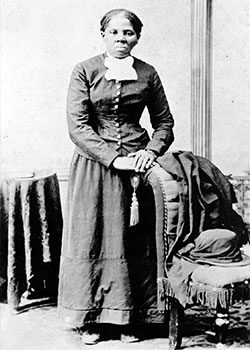
Harriet Tubman
1850: Harriet Tubman – first American woman to run an underground railroad to help slaves escape.
1869: Arabella Mansfield – first female lawyer in America; admitted to the Iowa bar.
1870: Louisa Ann Swain – first woman in the United States to vote in a general election.

Victoria Woodhull
1872: Victoria Woodhull – first woman to run for United States President.

Carro Clark
1900: Carro Clark – first American woman to establish, own, and manage a book publishing firm—C. M. Clark Publishing Company.
1916: Jeannette Rankin – first woman to hold high office in the United States—elected to Congress, as a Republican from Montana.
1920: Marie Luhring – first woman in America to become an automotive engineer.
1923: Florence King – first woman to win a case before the U.S. Supreme Court (Crown v. Nye).
1933: Frances Perkins – first woman cabinet member (Secretary of Labor), under Franklin Roosevelt.
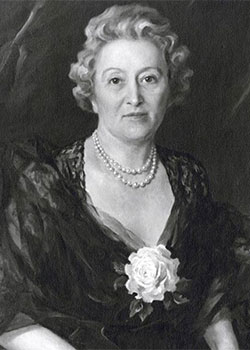
Lettie Pate Whitehead
1934: Lettie Pate Whitehead – first woman to serve as a director of a major corporation (The Coca-Cola Company).
1942: Anna Leah Fox – first woman to receive the Purple Heart (wounded in the attack on Pearl Harbor).
1948: Esther McGowin Blake – first woman in the U.S. Air Force.
1955: Clotilde Dent Bowen – the U.S. Army’s first black female physician to attain the rank of colonel.
1959: Arlene Pieper – first woman to officially finish a marathon in the United States when she finished the Pikes Peak Marathon in Manitou Springs, Colorado.
1963: Maria Goeppert Mayer – first American woman to win a Nobel Prize in Physics; she shared the prize with Eugene Paul Wigner and J. Hans D. Jensen.
1964: Isabel Benham – first female partner in R.W. Pressprich & Co.’s 55-year history, which also made her the first female partner at any Wall Street bond house.
1972: Katharine Graham – first female Fortune 500 CEO, as CEO of the Washington Post Company.
1976: Emily Howell Warner – first woman to become an American airline captain.

The Honorable Sandra Day O’Connor, justice of the U.S. Supreme Court, is shown, June 24, 1985. (AP Photo/Lana Harris)
1981: Sandra Day O’Connor – first woman United States Supreme Court justice.
1985: Libby Riddles – first woman to win the Iditarod.
1994: Judith Rodin – first permanent female president of an Ivy League university (University of Pennsylvania).
1999: Carly Fiorina – first woman to lead a Fortune 50 company (Hewlett-Packard)
2000: Lucille “Pam” Thompson – first African-American woman to be a U.S. Coast Guard Special Agent.
2009: Jeanne Shaheen – first woman to hold the offices of Governor (New Hampshire, 1997–2003) and U.S. senator (New Hampshire, since 2009).
2016: Adena Friedman – first female CEO of NASDAQ.
2018: Stacey Cunningham – first female President of the New York Stock Exchange.
The achievements listed here include gains in business, education, politics, athletics, the military, science, and more. Some were outliers—one-time wins for one specific woman, not to be repeated for years. However, every gain made helped pave the way for the next generation of women to move the sticks down the field toward the ultimate goal.
Women today are stepping up and stepping out as never before. They are also working together and organizing as never before. And we are seeing the results—as never before.
By Lorraine Hariton, President & CEO, Catalyst

In my recent travels throughout the UK and Canada, and back home in New York, one subject keeps coming up: the pay gap between women and men.
Twenty-three years ago, when the United States had its first Equal Pay Day, women were paid 74 percent of what their male counterparts made. That number has barely budged, with women earning, on average, 80 percent in 2017.
So, it might surprise you to learn that I am optimistic about the prospect for change.
At Catalyst, we are hearing from more and more global companies that feel the need to take strong action to tackle the pay gap if only because if they don’t, legislators will require it.
An Emerging Trend: Pay Transparency Laws
During my trip to the UK, I spoke with several corporate leaders about the Equality Act, which requires companies with more than 250 employees to publicly disclose salary information. The government is betting that publishing pay data will force companies into action and will empower employees to press for greater pay equity.
Germany also recently passed a law that lets women and men who work for companies with more than 200 employees learn the salary of coworkers in the same job. And, in 2018, Canada introduced pay equity legislation for the federal jurisdiction, requiring employers to examine compensation practices and ensure that women and men working in federally regulated workplaces receive equal pay for work of equal value.
Back in the United States, some companies are also getting candid about their pay gaps. Citigroup recently revealed that median pay for women employees was 29 percent less than for men in the company. Why publish such data? The reason is simple: they understand that you can’t improve what you don’t measure, and they are setting goals for improvement. Bloomberg’s 2019 Gender-Equality Index, which lists global companies that voluntarily share gender diversity data and practices, has more than doubled in size in the span of a year. And at Catalyst, 62 CEOs have now joined Catalyst CEO Champions For Change—a two-year-old initiative that involves sharing data on women’s advancement, so we can collectively measure and report progress.
Pay Inequity Is Bad for Business
The bottom line: More companies are stepping up because they know that it’s not just the right thing to do; it’s good for business too. In the era of #MeToo, when gender issues are in the spotlight, employees, investors, and customers are increasingly expecting companies to walk the talk. They also know that companies that embrace diversity and inclusion will be more successful at attracting talent.
And, they know it won’t be long until companies that fail to address fundamental inequities are left behind.
So far, the United States hasn’t adopted pay transparency regulations, but that could soon change; a federal judge recently ordered the Trump administration to reinstate a 2016 initiative requiring companies to report how much they paid workers based on gender and race. Advocates of this initiative (including Catalyst) believe that collecting this data will encourage employers to correct pay disparities.
Whether the Trump Administration will appeal the ruling is unclear, but what is very clear is that companies should get off the sidelines. More than 40 percent of U.S. mothers are sole or primary breadwinners; getting paid equally is a basic right.
Many years of research show that organizations can close the pay gap if they do the following:
- Conduct internal pay equity studies/analyses. You can’t fix what you don’t measure.
- Implement a “no negotiations” policy for men and women; studies show that when women negotiate for higher salaries, people react more negatively than they do when a man asks for more money. This directly contributes to the wage differences between women and men.
- Publish salaries or salary bands, along with explanations, and facilitate discussions to ensure lines of communications are clear and honest.
- Evaluate recruitment, promotion, and talent development systems for gender bias.
Gap Inc. took these measures and became the first Fortune 500 company to publicly disclose and validate that it pays men and women equally for equal work. (Which is why, in part, Gap won the Catalyst Award in 2016.)
For years, there has been broad consensus that women should be paid equally. Now, it is time for employers to back that up with policies proven to eradicate the gap. Those who don’t may soon find they no longer have a choice.

Lorraine Hariton
Lorraine Hariton is President & CEO of Catalyst, a global nonprofit working with some of the world’s most powerful CEOs and leading companies to help build workplaces that work for women. Lorraine’s extensive career includes senior-level positions in Silicon Valley, as well as leadership roles across the private, nonprofit, and government sectors. Catalyst’s vision and mission have long been a passion for Lorraine and she is honored to lead the organization at this crucial time and to help write the next chapter in its 56-year legacy of accelerating positive change for women.
By Michael Stuber, the European D&I Engineer

Michael Stuber, the European D&I Engineer, becomes a PDJ columnist for 2019
Since we launched Profiles in Diversity Journal more than twenty years ago, D&I has grown from an innovative niche topic to become a widely accepted and broadly tackled issue. At the same time, it has become more difficult to create attention for D&I, find new approaches, or increase the success of existing strategies. One pioneer, who started out about the same time as PDJ, deals with these questions in a specific way. He is European D&I Engineer Michael Stuber. And PDJ has invited him to become a columnist in 2019.
To introduce and frame Mr. Stuber’s upcoming contributions for our readers, PDJ conducted the following interview:
PDJ: How has your definition of diversity changed since you started to work on the topic in 1997?
MS: Our analysis shows two paradigm shifts that are quite fundamental. On the one side, diversity now embraces more topics than ever before, including business-specific criteria, and also explicitly includes all individuals of any given dimension. On the other side, diversity today is clearly positioned as a resource and a part of the D&I value chain. Its elements and tangible benefits were quite vague in the beginning.
PDJ: You have always advocated a European framework for D&I. Which specifics do you see today, in the context of globalization or vis-à-vis the United States?
MS: In the beginning, we first had to understand if diversity was as relevant and powerful in Europe or EMEA as in the U.S., where it first started. Then, the differing legal and national contexts got integrated and, at the same time, globalization also demanded more universal approaches. After twenty years, we initiated a pan-European study that confirmed that a European D&I framework exists. It reflects some specifics that relate to the EUwide non-discrimination regulation and to the integrated nature of the single market and a European identity in the concert of world regions.
PDJ: Does that mean there are significant differences between Europe and the United States in D&I today?
MS: In fact, we have observed an increase in shared Diversity & Inclusion “household” programs across North America and EMEA. This even meant that little attention was eventually given to persisting and, in part, increasing differences. These become apparent in the governance of D&I, the language, no-go areas, or the acknowledgement of prevailing barriers to be addressed. For example, the European concept of quota or the importance of diverse slates in the U.S. are often not fully understood or decoded by the respective other side of the Atlantic.
PDJ: This analysis could imply that different regional foci or strategies should be established. Do you see more overlap or differences going forward?
MS: The overlap is more significant than the differences. For the most part, this is due to the global megatrends including digital transformation, ongoing globalization of business, and increasing complexity. Unfortunately, populism and increasing resistance or even backlash against D&I also form part of the common ground we see in many parts of the world. Overall, the future D&I agenda will have a lot in common regardless of where we work on the topic and will have to change in similar ways as well.
PDJ: What are some of the changes that you have identified for the future of D&I?
MS: In fact, we have spent significant effort over the past four years to understand how we have to refocus D&I in light of the changes just mentioned. Some of them are not necessarily appreciated by D&I practitioners, and some need to be positioned differently, depending on the world region where you work. We see two main redirections. First, D&I has to become more integrated. This means we need to connect, and eventually dissolve, silos in our programs, measurement, and messaging. We have to make sure that each individual feels that he or she belongs to and benefits from our D&I frameworks in the same way. Secondly, D&I has to become more specific. This requires tailoring programs more to individual business models and organizational cultures, and copying less of the peer-group-related initiatives that lead to top ratings or rankings in indexes or awards.
PDJ: It sounds as if you have also revamped and refocused your own approach to D&I and to the research, publications, and consulting work you do. Can you give our readers a sense of how your approach has changed?
MS: It is true that we want to practice what we preach, and therefore we also had to revise some of the work we had done in the past. The result is our new ENGINEERING D&I approach that focuses on having an impact on each individual organization we work with. In order to achieve this, we combine the three i’s: Insight-based, international, and innovative. This means that we are rigorously using the huge body of research, also to react to populist messages or existing myths. Then we leverage international expertise and experience to make sure we create contextualized learning. And finally, we check each element for embedded assumptions and try to create out-of-the-box solutions that best address a given issue. This also describes the spirit in which I look forward to contributing to your journal in 2019!
PDJ: Thank you Michael. We look forward to your contributions.
Michael Stuber
Michael Stuber’s company hosts a D&I knowledge blog called DiversityMine, which contains more than 1,900 articles. He contributed an article on the future of D&I to the fall 2017 issue of PDJ and wrote about diversity and group think for the magazine’s fall 2018 issue.
By Donald Fan
Summary
The Challenge:
Technology and automation are redefining the enterprise, the workforce, and how work gets done. How can corporate America prepare for and respond to these unprecedented shifts, and ensure women and people of color are not falling behind?
The Approach:
The challenge requires corporate America to embrace a growth mindset and cultivate an inclusive and learning culture; offer an ecosystem with upskilling and reskilling opportunities, and resources for next generation talent; and leverage digitization and automation to maximize the full potential of an innovative workforce.
The Impact:
Digital transformation mandates lifelong learning as a strategic and growth imperative for corporate America.
The world is changing at an accelerated pace because of technology disruption and digital transformation. The future has arrived, driven by macro-trends like digitization, automation, AI, machine learning, an internet of things, and interconnectivity. The magnitude of the shift is significant for corporate America. But surprisingly little empirical evidence has captured either the magnitude of digital and technology disruption to our workforce and how work gets done or how we should react on a broad scale. We know we have a challenge, but we have little guidance regarding the right course of action. I have written this case study to share some examples of how we might prepare for tomorrow’s challenge related to business, talent, and work. I offer it as food for thought and a starting point for further discussion, rather than a solution.
1. Readiness as a Future Enterprise
Technology is transforming the landscape of corporate America. The average lifespan of an S&P 500 company is now less than 20 years—down from 60 years in the 1950s, according to Credit Suisse.
For business to thrive in the digital era, we must disrupt ourselves and replace our current business model with a new ecosystem. We must cultivate an inclusive culture that embraces innovative thinking and acts with agility and connectivity.
Winning today requires going beyond outperforming our competition. It requires winning in the marketplace, community, and society. Business exists to serve society because, in the long run, the interests of business and society converge. By striving to advance three bottom lines (people, planet, profit), companies can collaborate with their stakeholders to reshape global systems and tackle the complex challenges before us.
Faced with challenges driven by automation, Walmart partnered with McKinsey & Company, and other stakeholders, to initiate a study entitled America at Work: A National Mosaic and Roadmap for Tomorrow. The recently released report explores the impact of automation on future work and recommends ways in which communities might respond, based on the belief that business success depends on a sustainable workforce, strong local talent development, and thriving communities with a solid customer base.
Key insights from the research include:
- The future of work is not a dichotomy of urban versus rural or the coasts versus the American heartland.
- Almost 190 million people (about 60 percent of the U.S. population) live outside the metropolitan areas, which have the greatest capacity to respond to increasing automation.
- Automation means that jobs will get done differently, not that jobs will disappear.
- Six principal responses to automation include:
- reskilling and upskilling;
- boosting mobility in the labor market;
- building and maintaining infrastructure;
- creating new jobs;
- modernizing the social safety net; and
- strengthening education.
- Responding effectively to automation will require community- level collaboration by multiple stakeholder groups.
Walmart and the Walmart Foundation have also invested in NGOs and community organizations to support programs that accelerate cross-sector upskilling efforts for incumbent retail workers across the United States.
2. Readiness as a Future Workforce
Gone are the days when you work for 40 years at one job and retire with a good pension. Now, the average time in a single job is 4.2 years, according to the U.S. Bureau of Labor Statistics. What’s more, 35 percent of the skills a worker needs will have changed by 2020, regardless of industry. Employees can no longer master a single skill set and expect to skate by for the rest of their careers. Success in today’s business world calls for a continuous approach to learning.
To build a winning workforce, we must assess, curate, and engage an innovative workforce. Incubating a diverse and inclusive workforce is even more crucial for tomorrow’s business success.
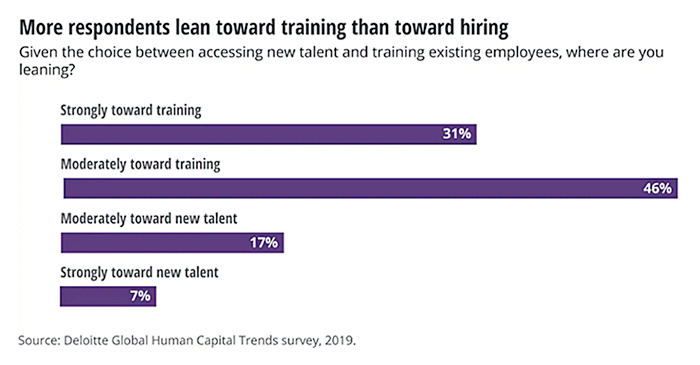
Companies have historically focused on external acquisition to find talent for new roles, but with the current growing skill shortage and low unemployment rates, we know that acquisition alone is not enough to access the capabilities we need. When employers were asked, in a recent Deloitte survey, how they would prefer to deal with issues of job redesign, more leaned toward training than toward hiring to obtain the talent they need.
Some companies are reskilling their workforces as a value unlock. AT&T has invested $1 billion in retraining nearly half its workforce for jobs of the future. SAP involved one-third of the employees in a major business unit in reskilling activities that included individual sixto eight-month learning journeys, and instituted workforce planning.
By providing the platform and resources to build learning agility, Walmart launched the Live Better U, bringing a suite of education benefits together to make it easier for all employees to learn about and access options designed to help them unlock their futures. The initiative includes Walmart’s $1 a Day College Program and tuition-free high school diploma or GED completion, as well as tuition discounts on advanced degrees, foreign language learning, and much more. Part of the Walmart Academy development program, Live Better U also allows employees to earn college credit for training they receive on the job.
Hundreds of thousands of Walmart employees have already undergone skills training equivalent to more than $317 million in college credits. In 2018, 500,000 field employees enrolled in 200 Walmart Academies to improve their skill sets and competencies, 62 percent of whom were female and 36 percent over the age of 45. Academy graduates are equipped with the knowledge, skills, and abilities they need to succeed in the competitive retail landscape of the future. The initiative successfully introduced virtual reality (VR) technology to enhance and improve the learning experience. Walmart is currently providing 17,000 VR devices to U.S. stores, which will enhance the training of 1.4 million employees.
Pathways, another Walmart training program, serves entry-level frontline employees. Every new employee enters the program within six months of hire and learns essential customer-service, merchandising, teamwork, and communications skills. To date, Walmart has trained more than 400,000 employees using the Pathways program.
In the past couple of years, Walmart has invested $2.7 billion to ensure the readiness of its future U.S. workforce.
3. Readiness as Future Ways of Working
The nature of work is changing quickly. According to a report from the World Economic Forum, the development of robots and automation in the workplace could create 58 million new jobs in the next five years.
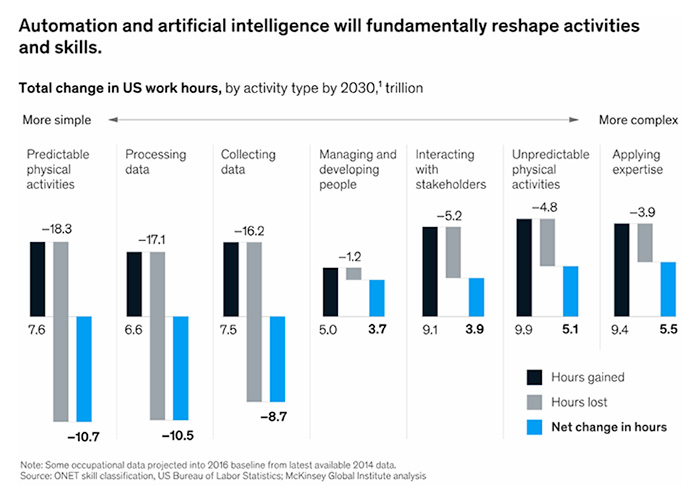
According to McKinsey & Company, as the demand for physical and manual skills declines, the need for technological skills, as well as social and emotional ones, will rise quickly in every sector.
A future enterprise must quickly change how it approaches work if it is to maximize workforce potential. To gain the advantage over its competitors, a company must employ cognitive and digital automation, as well as learning, unlearning, relearning, and applying knowledge.
Walmart is positioning itself to become a digital company in the future. The company was the third-largest investor in technology worldwide in 2018, recording 1,500 patents in the past few years and adding 1,700 IT professionals to its technology team in 2018 (another 2,000 IT professionals will be added in 2019). The company has also joined the CTA Apprenticeship Coalition, created by IBM and the Consumer Technology Association (CTA)™, to help its employees train for new IT jobs. With training conducted on the job, apprentices don’t have to invest as much money up front to learn the necessary skills.
Walmart is recognized as a pioneer in the application of technology and automation to elevate business. Robots, currently operating in hundreds of its stores, include Auto-C, a floor polisher and cleaner that only needs minimal help from humans in the form of prep work; Auto S, a robot that scans store shelves to make sure items are in the right place and have been priced correctly; FAST Unloaders, auto-unloaders that work in conjunction with Auto S to scan and sort inventory, so that what is needed most can be moved from truck to backroom to shelf in the fastest way possible; and Pickup Tower: an auto-vending machine that enables in-store customers to pick up their previously placed online orders in under a minute.
The use of robotics frees employees from mundane and repetitive tasks, allows them to better serve customers on the sales floor, and gives them more time to learn and apply new knowledge and skills.
The Walmart research mentioned earlier states that increasing automation means that jobs will get done differently, not that jobs will disappear. By raising employee readiness for different roles, Walmart is well positioned to create new jobs. In 2018, for example, the company created 30,000 new grocery delivery and pickup service jobs.
Neuroscience indicates that scenario-based learning can effectively teach hard and soft skills, and develop situational awareness, using cognitive (prefrontal cortex), emotional (amygdala and other limbic), and behavioral (basal ganglia) methods. Coupled with the application of various VR modules, Walmart adopted gamification to make reskilling and upskilling fun and engaging, while helping employees learn, retain, and apply new knowledge to a variety of in-store roles. One of the games was developed to train dry goods department managers. So far, it has been downloaded more than 100,000 times. The game puts the player in charge of the dry goods department in a Walmart store. The player faces a variety of challenges that a department manager might deal with daily. As a player successfully overcomes each challenge, he or she advances to the next level.
Conclusion
To conclude, I’d like to share the following call to action issued by the World Economic Forum’s Preparing for the Future of Work project:
- Foster a culture of lifelong learning in your company/ industry
- Encourage a lifelong learning mindset among all employees through the right incentive structure, leadership example, and communication strategy
- Build tailored training and upskilling programs relevant to jobs in your company and the industry more broadly, and make them widely available to all employees
- Define certifications for key skills that enhance talent mobility
- Facilitate job transition pathways with targeted reskilling programs
- Create strategic workforce planning and skill-mapping to identify gaps and opportunities
- Clearly communicate the benefits of reskilling, and create a sense of urgency for employee action
- Develop reskilling programs to enable job transitions from declining jobs to relevant growing jobs, and from current relevant jobs to emerging jobs requiring scarce skill sets
To thrive in the digital era, we must proactively prepare for and invest in the future by embracing change, adaption, and innovation. By reconfiguring business models, redefining jobs and work, retraining the workforce, and creating an inclusive and learning culture where employees and technology work together to achieve goals, we can get ahead of the game. Thus, we can turn a challenge into a promising opportunity, in terms of higher productivity, rising wages, and increased prosperity.

Donald Fan
Donald Fan serves as Senior Director in the Global Office of Culture, Diversity & Inclusion at Walmart Inc.